HOW WE THINK

Leadership success is not a standalone variable.

Organisations create value through people, but not every role contributes equally, and not every talented individual creates the same value in every environment. Leadership effectiveness emerges from the relationship between the individual, the organisation and the moment. Our work begins by understanding that relationship.

THE CRITICAL FEW

Not every role carries the same consequence.

Some roles have a disproportionate influence on strategic decisions, growth, transformation, organisational capability and business performance. They are not necessarily defined by seniority. Their importance lies in the outcomes they influence, and in the consequences of getting them wrong.

Our first task is to establish which roles matter most to the business, and what success in them will actually require.

The conversation shifts from filling a position to defining the leadership contribution required.

Two leaders in a candid discussion

THE CORE PRINCIPLE

Where, when and under what conditions capability creates the most value.

TALENT

×

What the leader brings: capability, experience, judgement, motivation, behavioural range and potential.

CONTEXT

×

Where they will lead: strategy, ownership, culture, governance, operating model and stakeholders.

TIMING

=

When they arrive: the stage of evolution, the mandate at hand, the urgency for change and the horizon for results.

VALUE

The enterprise value a leader creates, made or lost in the first 180 days.

Why the terms multiply

If any one term is zero, the result is zero. Strength in one cannot compensate for absence in another.

TalentContextTimingOutcomeWhat it looks like
✕✓✓Capability gapThe right organisation and the right moment cannot make up for a leader who lacks what the mandate demands.
✓✕✓Context failureA proven leader struggles in an ownership structure, culture or governance model they cannot read. Most leadership failures we see are failures of context, not capability.
✓✓✕Timing failureThe right leader at the wrong moment: a builder arrives when the business needs consolidation, or a turnaround leader after the turn.
✓✓✓ValueAll three align. The leader creates enterprise value within the first 180 days.

In practice

1

We map the context before we search: ownership, governance, culture and the constraints the leader will inherit.

2

We name the moment the role must serve, and the horizon over which results are expected.

3

Only then do we assess talent, against both, not against a generic profile.

LEADERSHIP POTENTIAL MARKERS

We assess for the role ahead, not only the one behind.

Leadership Behaviour shows how a leader leads today. Potential shows how far they can grow: into a larger role, a more complex business, or a mandate that does not exist yet. We read it through five markers, each assessed on its own and then alongside the other four lenses.

01

SYNTHESISE

The ability to make sense of complexity.

Pulls information from many sources into a clear picture, and keeps doing so as problems grow larger and less defined.

WHAT WE LOOK FOR

  • Joins up information others treat as separate
  • Frames the real problem before solving it
  • Stays clear as ambiguity rises

02

INFLUENCE

The ability to bring people together.

Builds trust and alignment across groups with very different interests, without relying on title.

WHAT WE LOOK FOR

  • Earns trust from people who see things differently
  • Creates alignment where interests compete
  • Builds the capability of people around them

03

DRIVE

The ambition to go further, and the determination to get there.

Reaches for more than the role asks and sees it through, aiming that ambition at the success of the business.

WHAT WE LOOK FOR

  • Sets goals beyond what the role demands
  • Sustains effort through long, uncertain stretches
  • Ambition that serves the enterprise

04

EVOLVE

The instinct to question, learn and anticipate.

Learns fast in unfamiliar territory and changes their own approach before circumstances force them to.

WHAT WE LOOK FOR

  • Seeks out what they do not yet know
  • Asks for feedback and acts on it
  • Sees what is coming before it arrives

05

UNDERSTAND

The awareness to navigate human complexity.

Knows their own strengths, triggers and blind spots, stays composed under pressure, and reads what goes unsaid.

WHAT WE LOOK FOR

  • Knows where they are likely to derail
  • Stays steady when stakes rise
  • Reads the motives and emotions of others accurately

A leader with high potential can still be the wrong appointment if the fit, the organisation or the moment is wrong. That is why Leadership Potential is read with the other four lenses of the Shhyfft Leadership Success Framework. A partner leads every judgement.

LEADERSHIP POTENTIAL MARKERS

We assess for the role ahead, not only the one behind.

Every senior appointment is a judgement about what a leader will do next, often in a role and a context they have not yet met. Our five Leadership Potential Markers give that judgement a structure. Each is read against the specific demands of the mandate, not against a generic ideal.

Empathy

Reading and regulating one’s own emotions, and understanding and responding effectively to others.

Growth

The inclination and ability to learn, question assumptions and navigate change.

Determination

Sustaining purposeful effort, navigating adversity and following through.

Vision

Business perspective, the quality of decisions and the ability to see where the organisation must go.

Connection

How a leader engages people, builds relationships, influences and collaborates.

Leadership Potential is one of the five lenses in the Shhyfft Leadership Success Framework.

CULTURE CAPITAL

Capability matters. So does how it is expressed.

Our Culture Capital framework examines the formal and informal dynamics of how a leader operates, through four core tenets.

1 · HOW THEY CONNECT

Relational adaptability

How an individual engages people, navigates hierarchy, handles conflict and creates space for others.

2 · HOW THEY THINK

Decision register

How an individual approaches ambiguity, balances evidence and instinct, and responds to dissent.

3 · HOW THEY SEE THEMSELVES

Status and identity

How an individual relates to authority, recognition, feedback and perceived threats to status.

4 · WHAT THEY STAND FOR

Principled consistency

How stated values translate into behaviour when accountability, transparency or ethics carry a cost.

Default vs. range

We distinguish between a person’s typical style and their deliberate breadth of adaptability. Cultural capital is about understanding operational friction and alignment, not mere assimilation.

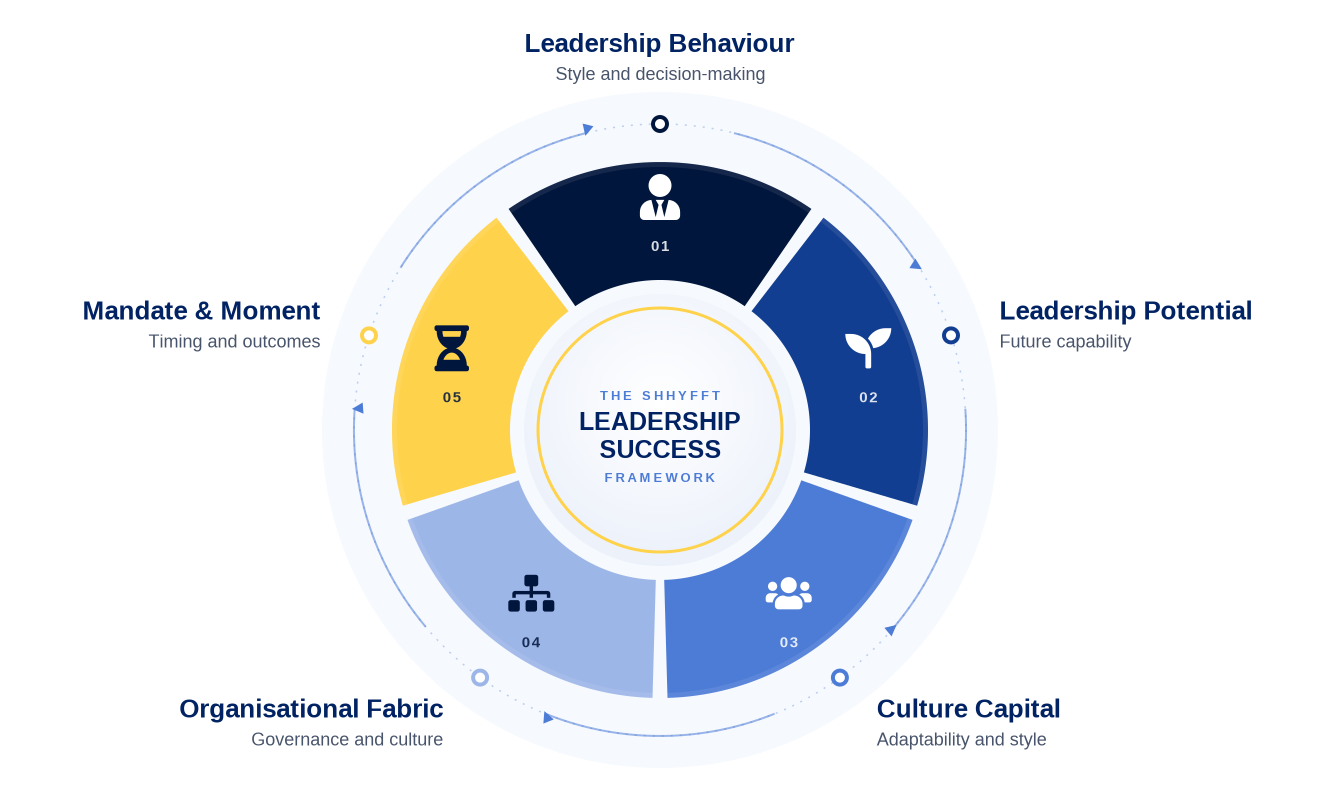
THE SHHYFFT LEADERSHIP SUCCESS FRAMEWORK

Five interconnected lenses, read together.

Reading the five together shows where alignment is strongest and what could create friction. It also tests whether a new appointment is the answer at all, or whether the better course is to develop internal talent or redesign the role.

The Shhyfft Leadership Success Framework: five interconnected lenses around leadership success

1

Leadership Behaviour

Style and decision-making

2

Leadership Potential

Future capability

3

Culture Capital

Adaptability and style

4

Organisational Fabric

Governance and culture

5

Mandate & Moment

Timing and outcomes

FROM APPOINTMENT TO VALUE REALISATION

A leadership appointment is a beginning.

Value depends on clarity of mandate, authority to act, stakeholder alignment and transition support.

Leadership success is an organisational responsibility.

A leadership appointment being agreed

One philosophy. Three applications.

Executive Search

Evaluating leaders against business mandates and context, not just résumés.

Leadership Hiring as a Service

Structured, repeatable hiring connected directly to business priorities.

Shhyfft Advisory

Addressing succession, role design, alignment and the conditions for performance.

OUR CONVICTION

Better leadership decisions begin with better questions.

  • Which roles matter most
  • What success will require
  • What conditions let talent translate into value

We don't search for the best person. We search for the right answer.